Biography:

Germ politics:
Did Florence Nightingale accept the ‘germ theory’ of disease?
Yes. She accepted the germ theory before many doctors, soon after Louis Pasteur’s discovery of microorganisms. But she maintained that there are other ways to deal with infection besides fighting germs. Most doctors were ignoring these alternatives.
Authors writing before 1998 claimed (wrongly) that she never accepted the germ theory, and many people still rely on obsolete authors. These authors seemed to use the “never” to differentiate her from most of her highly distinguished medical contemporaries who were slow to take on board the pioneering work of Pasteur and Lister. Thus Florence Nightingale “never believed that germs caused disease.” – St. Thomas’s Hospital, by E. M. McInnes, and again “never accepted the germ theory of disease” – Ever Yours, Florence Nightingale: Selected Letters by Vicinus and Nergaard (p. 2). Serious books like these, by presenting no evidence to sustain their claims, created the impression that the issue was beyond dispute. In reality by her mid-forties, when germ theory was still not widely accepted, Nightingale was writing a medical textbook (see below) specifically instructing nurses to kill germs.
When did modern germ theory appear?
Louis Paster first demonstrated the existence of infectious microorganisms in the early 1860s, though his discovery was rejected by many medical professionals. In 1865 the surgeon Joseph Lister used carbolic acid spray during operations to prevent infections. This showed that Pasteur’s findings had practical applications in medicine.
The germ theory changed as more scientific evidence came to light. At first, many medical people believed that person-to-person infection could only occur through physical contact (the original meaning of ‘contagion’), not through the air. It was also believed for many years that transmission was not possible except from a person already showing symptoms (‘Koch’s first postulate’).
How did Nightingale’s beliefs change?
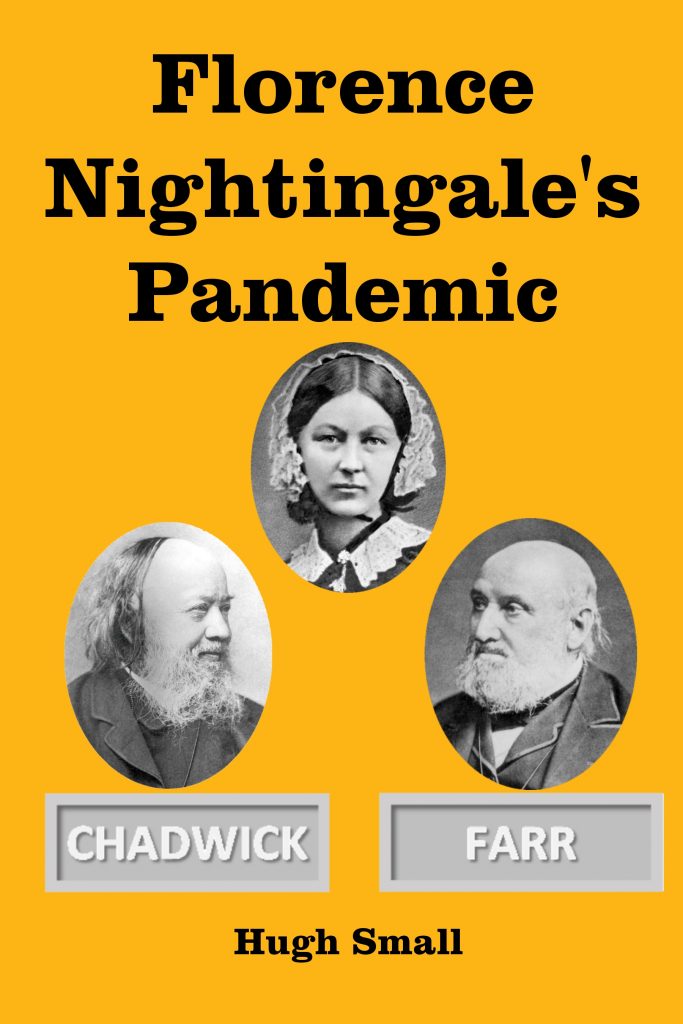
Nightingale relied on the medical teaching of her mentor Dr William Farr. Before the 1870s they probably both believed that infection, except in specific cases like syphilis, was caused by inanimate chemical substances carried in the air. This was closer to modern germ theory than either the ‘contagionist’ view of the mainstream medical profession of the day or Koch’s first postulate. Farr continually updated his views and by the mid-1870s seems to have persuaded Nightingale to recognise that pathogens carried in water or on objects can cause disease.
Did she teach nurses about germs?
Yes. She advised nurses to use a chemical hand sanitiser to kill germs. Lister’s carbolic acid produced skin irritations, so she endorsed the use of bleach instead:
“Always have chlorinated soda for nurses to wash their hands, especially after dressing or handling a suspicious case. It may destroy germs at the expense of the cuticle, but if it takes off the cuticle, it must be bad for the germs”.
She wrote this in 1876 for Dr Richard Quain’s projected Medical Dictionary which was finally published in 1882. It was only then that germ theory was first taught in medical schools.
Lister abandoned carbolic acid antiseptic in the 1880s when he decided that its effects were harmful to surgical staff and its protection was no better than careful cleaning of instruments and skin. By the 1890s he had adopted aseptic technique. When Nightingale came to hear about the aseptic methods (excluding germs rather than killing them with chemicals) she became a great enthusiast for them. Ellen Ekblom, Head Surgical Sister at the Helsinki Surgical Hospital in Finland, told Nightingale in 1896 of the aseptic methods used in that hospital, including heating catheters to 120 degrees and boiling swabs in blotting paper which the nurse opened without touching the swab. Nightingale said: “I wish I had known this when we wrote for Quain’s”. In Quain’s she had recommended disinfecting catheters antiseptically, using carbolic acid.
Is 1896 a late date for conversion from antiseptic to aseptic ideas? Not if you consider that the date of first introduction of a practice is not a good guide to widespread adoption, because of the conservatism of medical practitioners. Steam sterilisation of dressings was pioneered in Germany in 1886, and sterile rubber gloves for operations were first used in 1890. But my father, when a young surgeon in the East End of London in 1933, assisted a senior colleague of the old school who still performed abdominal surgery the antiseptic way nearly half a century later, dousing his bare hands, swabs, and instruments in lysoform and often smoking a cigarette while he operated. Alan Small described the experience in his obituary of the old surgeon, A. J. Couzens, published in the British Medical Journal in 1960.
Nightingale’s Quain’s article contains an example of her criticism of doctors’ misuse of germ theory: “.. the doctrine of ‘disease germs’, in the sense in which it may lead to considering ‘infection’ inevitable, must not be taught as a principle of sanitary nursing.” She is referring back to her dispute with John Simon, Britain’s Chief Medical Officer, who in 1858 had claimed that the high death rate from measles and scarlet fever was “unavoidable”. She attacked his official pronouncement publicly, and he later retracted his statement. She concluded that medically qualified individuals cannot be satisfactory public health managers unless they abandon their medical careers. Belief in the myth that she did not understand germs has caused governments to ignore this wise observation ever since.
Who started the story that Nightingale did not believe in germs?
The first author to claim that Nightingale did not believe in germs may have been Lytton Strachey, who wrote in his Eminent Victorians (1924) that Nightingale believed there was no such thing as infection. Strachey got his material almost entirely from Cook’s 1913 biography of Nightingale. Perhaps Strachey was influenced by Cook’s mention of the Jervoise Clarke Jervoise pamphlet on infection (see below).
Hs anyone produced ‘evidence’ that she did not believe in germs?
1. F.B. Smith (in his biography of Nightingale) and Royston Lambert (in his biography of John Simon) wrote that her disagreement of Simon and Greenhow in 1858 showed that she did not accept modern science. My 1998 book Florence Nightingale: Avenging Angel (“FNAA”) was the first to analyse this dispute and found that she was right and Simon and Greenhow were wrong. Despite claiming to be experts in sanitary science, as practising medical men they did not understand it.
2. Monica Baly cited Nightingale’s corrections to Amy Hughes’ book on District Nursing as proof that Nightingale objected to precautions against germs. FNAA showed that Baly had not examined the corrections carefully. In fact Nightingale made improvements to Hughes’ germicidal advice.
3. F.B. Smith claimed that her cancellation of the Francis Galton legacy (“endowing a microbe”) showed that she didn’t believe in microbes. This also I rebutted in FNAA.
4. Jervoise Clarke Jervoise, a prominent opponent of vaccination and germ theory, claimed that she endorsed his views and added some supposed “remarks by Miss Nightingale” to his pamphlet on the subject. Cook included the following entry in his Bibliography: “Infection.” By Sir J. Clarke Jervoise, Bart., with Remarks by Miss Nightingale. This may possibly the origin of Strachey’s claim.
Examination of the pamphlet shows that it may not be a reliable record of Nightingale’s comments, but even if she made the remarks exactly as claimed, the most that can be said is that in 1867 – the year in which she is said to have made these remarks – she found fault with a primitive contagionist “germ hypothesis” that was current at that time.
These “remarks” attributed to Nightingale are not signed by her, and there is no mention of them or of Jervoise in her archives. They were signed “Anon” – possibly indicating that they are hearsay from an anonymous witness describing her alleged comments on the pamphlet and on germs. There is no doubt that Nightingale frequently made critical remarks on the doctors’ abuse of their earliest germ theories which would have convinced a lot of die-hard opponents of any germ theory that she was on their side. Jervoise’s pamphlet attacked quarantine regulations and claims the Medical Officer of the Privy Council was ignorant and dictatorial, which Nightingale would have agreed with. However the remarks deny the possibility of infection, which Nightingale was prominent in admitting.
One of the problems of analysing Nightingale’s criticisms is that she was attacking a moving target: the “germ hypothesis” evolved rapidly under attack, forming its own new, resistant strains (the later “immune carrier” modification is a good example). In an earlier Note on Contagion in 1858 she had specified that she did not believe a then-current germ theory (soon afterwards shown to be false) that held that epidemics were caused by germs attaching themselves to objects. Clarke Jervoise did not include enough context in the “remarks” to say exactly what germ theory she was attacking in 1867. Whatever it was, it was a very early variety. Lister had first demonstrated the impact of microbes on health only two years before.
5. Her notes on a letter from Luise Fuhrmann (1889)
Fuhrmann wrote to someone in England and Nightingale has copied out the letter (BL Add MSS 45809 f94) and made some enigmatic jottings on the copy which show that she disagrees with the way some doctors employ the germ theory.
Miss Fuhrmann writes: “It seems that people in England have got the Certificate disease (or Register disease) for they attach a meaning to such a piece of paper which it has not got even in our bureaucratic country where one gives & gets certificates for anything & everything.”
Nightingale has written below:
“and who is to certify our certificates … The germs-disease is most dangerous and fatal – not to the Patient but to the Doctor. Bacteriology is likely to be prove a lethal Epidemic.
Nightingale is suggesting that too much emphasis on germs may be detrimental to medicine. This is an issue which is still debated today.
6. Her letter (BL Add MSS 45767) to Douglas Galton (1893)
Nightingale is writing to Galton about an impending Buckinghamshire County Council Sanitary Commission meeting.
“Did you notice that the Commission of Eminent men on Leprosy came to the conclusion that Leprosy is the direct consequence of a bacillus. They do not say of want of cleanliness, especially personal, foul food, especially putrid fish &c &c
God forbid that the Bucks Sanitary Conference should come to the conclusion that Typhoid Fever, Diphtheria &c &c of which they have had a great deal are the direct consequences of Bacillus F, Bacillus D. Instead of bad drainage, cess pools instead of dry earth closets, fouled water supply &c &c”
In this letter to Galton she says that public health authorities should not content themselves with identifying the strains of bacteria that produce Leprosy, Typhoid, and Diphtheria but should instead emphasise the impact of bad sanitation. Her viewpoint is scientific and consistent with her statements – in her Quain’s article 11 years earlier – that precautions are necessary in hospital to stop the spread of disease through germs.